How to read the timeline
The name on the vehicle.
The role behind the design.
Each entry identifies its manufacturer, project date and Ferdinand Porsche’s documented role. A programme, prototype, production derivative and modern reconstruction are distinguished in the descriptions. The register grows with the evidence; it does not claim that every vehicle associated with his name was designed by him personally.
51 documented entries across the engineering years, the sports-car transition and agricultural successors.
Chapter one · Before the sports-car marque
Ferdinand Porsche.
The engineering years.
From earlier employers to the design office founded in 1931: these are the documented vehicles, experiments and client commissions. The names of the actual manufacturers remain part of the record.
- Life & company history
Ferdinand Porsche — the beginning
- Manufacturer / organisation
- Before the Porsche company
- Design attribution
- Ferdinand Porsche, before the engineering office and sports-car marque
Born in Maffersdorf in Bohemia, Ferdinand Porsche became interested in electrical engineering. He began work at Béla Egger & Co in Vienna in 1893, long before an independent Porsche company existed.
What followedHis early career developed through work for other manufacturers. Their vehicles retain their original maker identities in this history.
Original sources
- Electric & hybrid
Egger-Lohner C.2 Phaeton
- Manufacturer / organisation
- Béla Egger / Ludwig Lohner
- Design attribution
- Electric-drive engineering by Ferdinand Porsche while employed by Béla Egger; bodies by Lohner
This early electric carriage used an enclosed octagonal motor near the rear axle. The Porsche Museum records four chassis with different bodies from the Viennese carriage builder Ludwig Lohner.
What followedOne example won a Berlin competition in 1899. The museum identifies the C.2 as the oldest surviving Ferdinand Porsche construction; it predates the Porsche sports-car marque by half a century.
Original sources
- Electric & hybrid
Lohner-Porsche Electromobile
- Manufacturer / organisation
- Jacob Lohner & Co
- Design attribution
- Ferdinand Porsche working for the Viennese coachbuilder Lohner
Presented at the Paris Exposition, the electric Lohner-Porsche put drive motors in its front wheel hubs. It was an alternative to the motor-and-transmission arrangement of the earlier C.2.
What followedThe Lohner-Porsche drive system became the basis for several passenger and commercial vehicles. Lohner was the manufacturer; the Porsche company was still decades away.
- Electric & hybrid
La Toujours Contente — four electric drive wheels
- Manufacturer / organisation
- Jacob Lohner & Co
- Design attribution
- Ferdinand Porsche developing the Lohner-Porsche system
Porsche extended the wheel-hub idea to a competition vehicle with a motor at each wheel. This made all four wheels part of the propulsion system.
What followedThe experiment demonstrated another application of electric wheel-hub drive. It was a Lohner-era vehicle, rather than an early production Porsche sports car.
- Electric & hybrid
Semper Vivus — the hybrid experiment
- Manufacturer / organisation
- Jacob Lohner & Co
- Design attribution
- Ferdinand Porsche at Lohner
The experimental Semper Vivus combined petrol engines and generators with electric wheel-hub propulsion. Carrying its own electricity-generating equipment offered a way to reduce dependence on batteries and charging stops.
What followedPorsche developed the approach further for the production-ready Mixte of 1901. The experimental vehicle and the later customer version belong to separate development stages.
Original sources
- Commercial & industrial
Beyond cars — buses, trucks, fire vehicles and taxis
- Manufacturer / organisation
- Jacob Lohner & Co / Lohner-Porsche system applications
- Design attribution
- A modular system developed by Ludwig Lohner and Ferdinand Porsche
The wheel-hub system was developed in different sizes for passenger cars, buses and heavier trucks. Porsche’s historical account also records fire-service vehicles in Vienna and taxi use.
What followedThis entry groups several applications, not one model. Exact chassis and construction dates need separate records.
- Electric & hybrid
Lohner-Porsche Mixte — a customer-car development
- Manufacturer / organisation
- Jacob Lohner & Co
- Design attribution
- Ferdinand Porsche and Lohner construction chief Otto Grünwald
The fahr(T)raum museum credits Porsche and Otto Grünwald with the Mixte. A petrol engine drove a generator supplying the wheel-hub motors, taking the hybrid idea towards a customer vehicle.
What followedEmil Jellinek financed seven early long-distance examples. The museum distinguishes the Daimler-supplied engine from the Lohner vehicle and its electric drive system.
Original sources
- Military & wartime
Military trucks and the Landwehr road-and-rail train
- Manufacturer / organisation
- Austro-Daimler
- Design attribution
- Ferdinand Porsche during his employment at Austro-Daimler
Porsche’s Austro-Daimler work included trucks and the Landwehr train for the imperial army. The train could operate on roads and railway tracks, extending his engineering work into military transport.
What followedThese dates mark his Austro-Daimler employment, rather than individual model build years. Military transport developed alongside passenger and competition cars.
Original sources
- Road cars
Austro-Daimler Maja
- Manufacturer / organisation
- Austro-Daimler
- Design attribution
- Ferdinand Porsche helping develop Emil Jellinek’s Maja project after joining Austro-Daimler
After Porsche joined Austro-Daimler in 1906, the Maja was presented at the Vienna Automobile Exhibition in February 1907. It marked his move into conventional petrol-car design.
What followedTransmission problems left cars unsold; Austro-Daimler reworked the project as the AD 28/32.
Original sources
- Road cars
Austro-Daimler AD 28/32
- Manufacturer / organisation
- Austro-Daimler
- Design attribution
- Porsche and the Austro-Daimler team revising the Maja; the museum names Eduard Fischer as a collaborator
The AD 28/32 reworked the Maja’s design. The fahr(T)raum example has coachwork by Cerny for Archduke Leopold Salvator and is dated 1908 by the museum.
What followedIt represents a revised production car within Austro-Daimler’s range. The date identifies the museum example.
Original sources
- Racing & record cars
Austro-Daimler Prinz Heinrich car
- Manufacturer / organisation
- Austro-Daimler
- Design attribution
- Ferdinand Porsche as Austro-Daimler designer and competition driver
Porsche developed a streamlined, high-performance Austro-Daimler and drove to victory in the 1910 Prince Henry Tour. Competition was already part of his engineering career while he worked for another manufacturer.
What followedThe success belongs to Austro-Daimler’s history. It is an early engineering and competition milestone, separate from the Porsche-badged sports cars launched under Ferry Porsche after the war.
Original sources
- Racing & record cars
Austro-Daimler ADS R “Sascha”
- Manufacturer / organisation
- Austro-Daimler
- Design attribution
- Ferdinand Porsche’s Austro-Daimler team, supported by Alexander “Sascha” Kolowrat-Krakowsky
The lightweight, two-seat ADS R was the racing branch of a proposed affordable four-seat car. Four prototypes were completed for the 1922 Targa Florio, where the small-engined Austro-Daimlers achieved a class victory.
What followedThe board declined the proposed series car on financial and market grounds despite further racing successes. Porsche left Austro-Daimler in 1923. The race drivers were separate from the project’s designer; this entry does not claim Ferdinand drove the class-winning car.
- Road cars
Mercedes 15/70/100 PS and 24/100/140 PS
- Manufacturer / organisation
- Mercedes / Daimler-Motoren-Gesellschaft
- Design attribution
- Ferdinand Porsche’s DMG development work, continuing Paul Daimler’s supercharger approach.
Two six-cylinder supercharged luxury models debuted at the Berlin motor show in December 1924. Offered with sporting and formal bodies, they demonstrate that Porsche’s Daimler work extended beyond racing cars.
What followedMercedes-Benz traces these cars into its later luxury and S-series lineage. Their manufacturer identity is Mercedes, rather than the later Porsche sports-car marque.
- Racing & record cars
Mercedes 2-litre Targa Florio racer
- Manufacturer / organisation
- Mercedes / Daimler-Motoren-Gesellschaft
- Design attribution
- Developed under Ferdinand Porsche at DMG; based on Paul Daimler’s earlier design.
After becoming DMG’s technical director in April 1923, Ferdinand Porsche brought the two-litre supercharged racing car to competition readiness. Its earlier design work belonged to Paul Daimler.
What followedChristian Werner won the Targa Florio and Coppa Florio in 1924. The car restored by Mercedes-Benz in 2024 was Christian Lautenschlager’s example; Werner’s winning car has not survived.
Original sources
- Road cars
Mercedes-Benz Modell K
- Manufacturer / organisation
- Mercedes-Benz / Daimler-Benz
- Design attribution
- Developed under Ferdinand Porsche’s technical leadership.
The shortened, higher-output Modell K helped establish the supercharged touring-car family from which the Type S evolved. Its K designation referred to the shortened chassis.
What followedThe programme linked everyday touring cars with competition development. It preceded the S, SS and SSK rather than being a Porsche-branded production car.
- Road cars
Mercedes-Benz Type S
- Manufacturer / organisation
- Mercedes-Benz / Daimler-Benz
- Design attribution
- Part of the S-series developed during Ferdinand Porsche’s Daimler tenure.
Derived from the 1926 Modell K, the Type S combined a lowered sporting chassis with a large supercharged six-cylinder engine. It belonged to a Mercedes-Benz programme serving both road customers and competition.
What followedRudolf Caracciola won the sports-car race at the Nürburgring’s opening on 19 June 1927. The line continued through the SS and SSK.
- Road cars
Mercedes-Benz Type SS
- Manufacturer / organisation
- Mercedes-Benz / Daimler-Benz
- Design attribution
- S-series development under Ferdinand Porsche and the Daimler-Benz engineering team.
The Super Sport developed the S-series into a more powerful sporting model. Mercedes-Benz records a three-car victory for the SS at the German Grand Prix in July 1928.
What followedThe SS also provided the technical basis for the shorter-wheelbase SSK. Road versions and competition cars should retain their separate specifications.
- Road cars
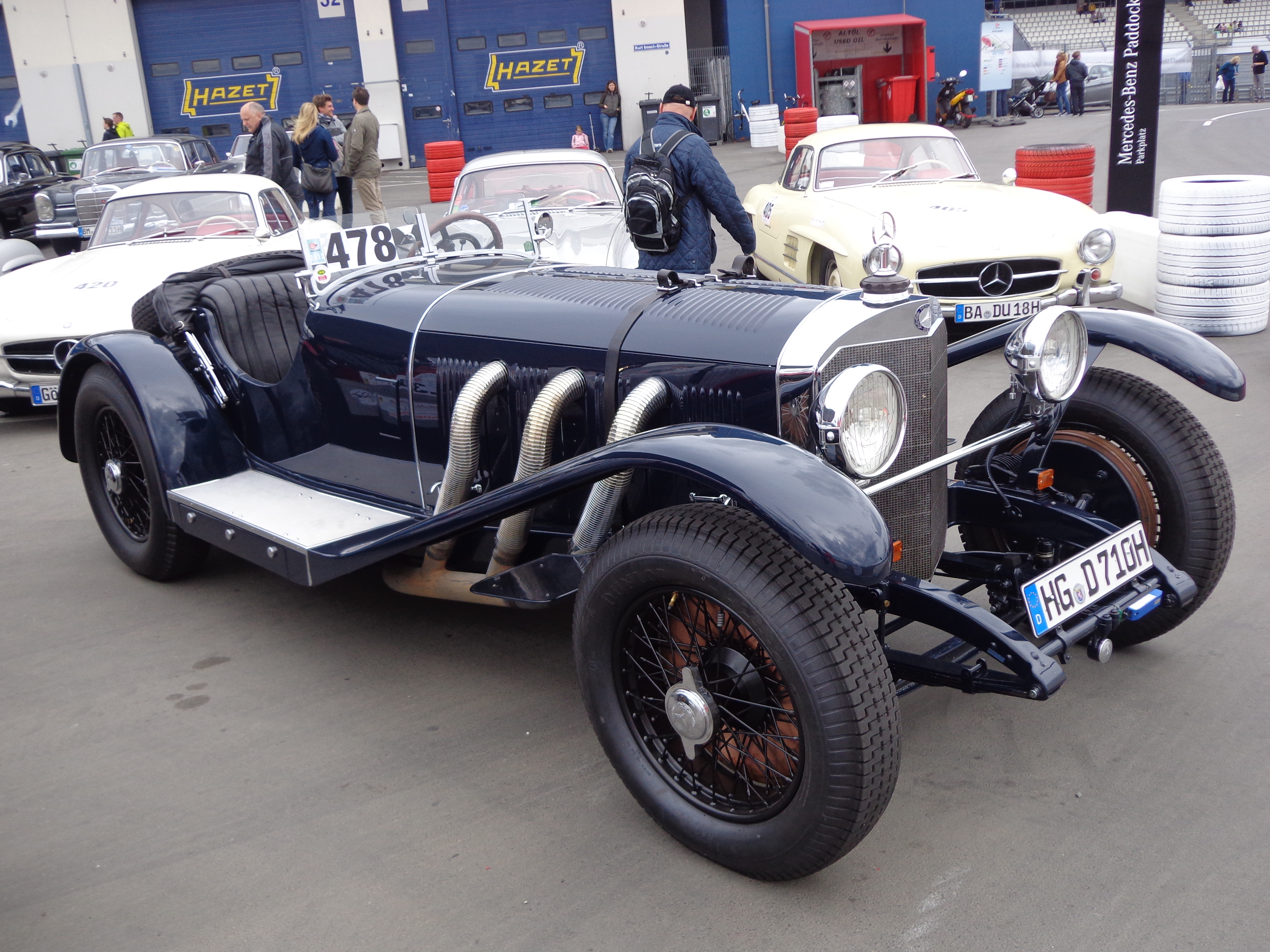
Image: Chattus · CC BY-SA 4.0 Mercedes-Benz Type SSK
- Manufacturer / organisation
- Mercedes-Benz / Daimler-Benz
- Design attribution
- Developed during Ferdinand Porsche’s final year at Daimler-Benz.
The Super Sport Kurz shortened the SS wheelbase from 3,400 to 2,950 mm for greater agility on winding hill-climb courses. It retained the supercharged S-series powertrain concept.
What followedMercedes-Benz’s later racing development continued after Porsche left at the end of 1928. The 1931 SSKL should therefore not be presented as his new personal design.
- Road cars
Steyr Austria
- Manufacturer / organisation
- Steyr-Werke
- Design attribution
- Designed during Ferdinand Porsche’s appointment as Steyr’s technical director.
Porsche joined Steyr in early 1929 after leaving Daimler-Benz. Porsche’s historical account identifies the eight-cylinder Steyr Austria among his creations there.
What followedHe left Steyr in 1930 as cooperation with Austro-Daimler restricted his independence. The Austria belongs to Steyr’s development history.
- Life & company history
The independent Porsche engineering office
- Manufacturer / organisation
- Porsche engineering office, Stuttgart
- Design attribution
- Ferdinand Porsche and the engineering office’s founding team
The independent engineering company opened in Stuttgart in 1931. Its role was vehicle design and consultancy for clients, before a Porsche sports-car marque existed.
What followedEarly client commissions and later prototype programmes belong to this engineering-office chapter. The Porsche-badged sports-car business began under Ferry Porsche in 1948.
- Road cars
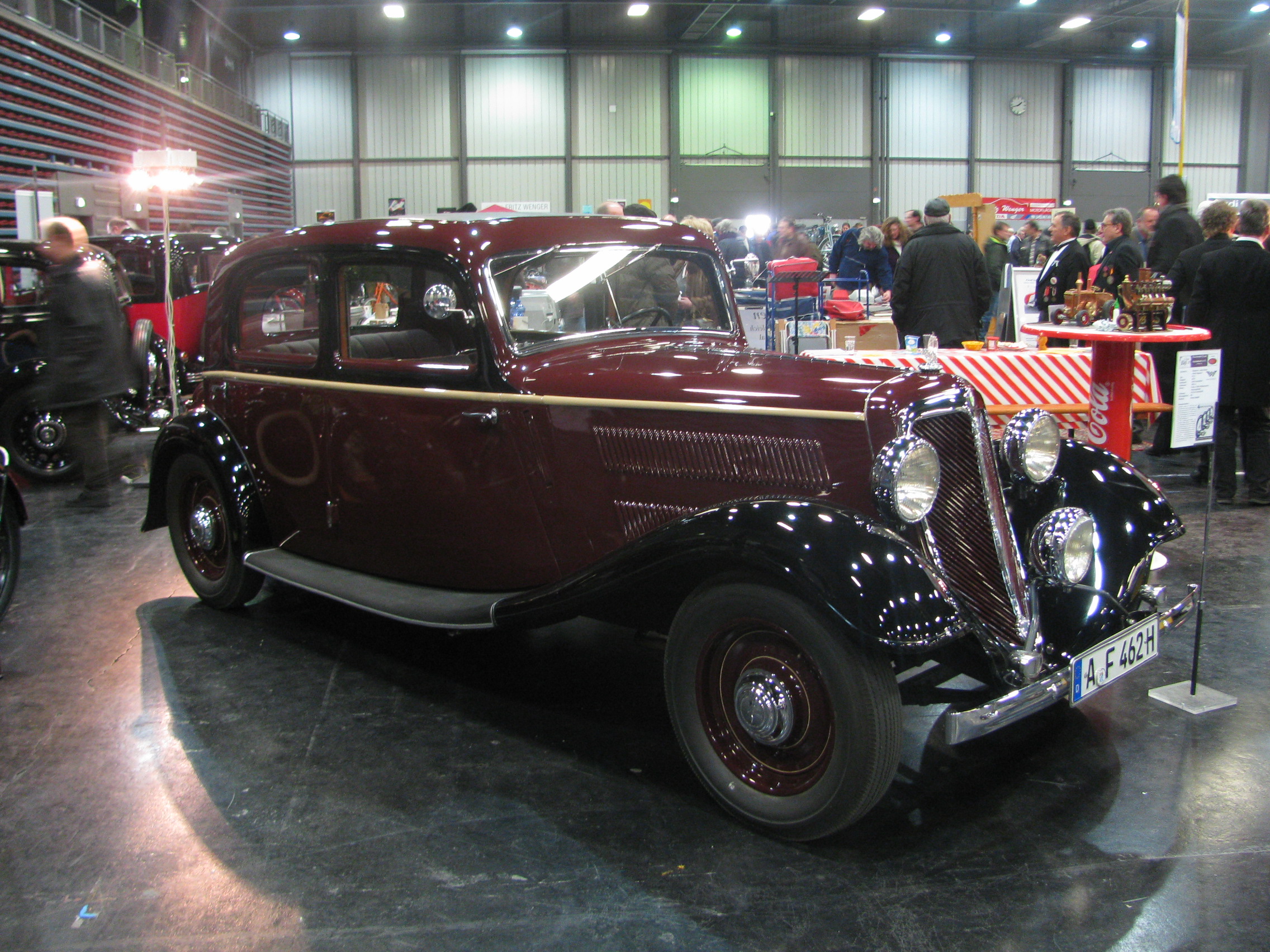
Image: Gwafton · CC BY-SA 3.0 Wanderer Type 7 and the W21/W22 lineage
- Manufacturer / organisation
- Wanderer
- Design attribution
- Client engineering by Ferdinand Porsche’s independent office and its team.
Wanderer placed one of the new office’s first major orders. Work included a six-cylinder engine and chassis; Porsche’s historical account connects the resulting mid-range car with the production Wanderer W21/W22.
What followedThis was an engineering commission for another manufacturer. The production Wanderer name and build date must be distinguished from Porsche’s earlier internal project numbers.
- Life & company history
Type 8 eight-cylinder client vehicle
- Manufacturer / organisation
- Wanderer / Porsche engineering-office project
- Design attribution
- An early complete-vehicle project of Ferdinand Porsche’s engineering office.
Porsche Engineering identifies the Type 8 as the office’s first complete vehicle, following its initial Wanderer engine-and-chassis work in 1931. It used an eight-cylinder engine.
What followedThe Type 8 did not enter series production. It demonstrates the office’s early whole-vehicle capability, before Porsche existed as a sports-car marque.
Original sources
- Road cars
Zündapp Type 12 small-car project
- Manufacturer / organisation
- Zündapp
- Design attribution
- Designed by the Porsche engineering office for motorcycle manufacturer Zündapp.
The rear-engined small car used a five-cylinder radial engine and a streamlined body. The commission offered Ferdinand Porsche a route towards his long-standing aim of an affordable car.
What followedThe project was shelved as Zündapp’s motorcycle business recovered. Its layout informed subsequent small-car work; it was never a production Porsche car.
- Life & company history
Audi Front UW: a Porsche-designed engine, not a complete Porsche design
- Manufacturer / organisation
- Audi / Auto Union
- Design attribution
- Porsche designed the Wanderer engine used by Audi; this does not attribute the entire car to him.
The front-wheel-drive Audi Front UW used an engine developed by Ferdinand Porsche for sister company Wanderer in 1931. The car was manufactured at Horch’s Zwickau factory.
What followedThis entry follows the reuse of engineering work across Auto Union’s brands. Audi’s complete vehicle, its front-drive arrangement and its body should not be credited to Porsche solely because of the engine.
Original sources
- Racing & record cars
Auto Union Type 52 Schnellsportwagen
- Manufacturer / organisation
- Auto Union
- Design attribution
- A road-and-racing proposal by Auto Union and Ferdinand Porsche’s design office.
Sketches began in late 1933 and became more detailed in 1934. The planned enclosed, three-seat car adapted the V16 Grand Prix concept for road use and long-distance competition.
What followedAudi says the original test car was never built and the project ended in 1935. Its modern reconstruction was completed in 2023 and publicly presented in 2024; that car is not a surviving 1930s prototype.
- Racing & record cars
Auto Union Type A / Porsche Type 22
- Manufacturer / organisation
- Auto Union
- Design attribution
- Commissioned from Ferdinand Porsche’s engineering office; construction and testing involved Auto Union’s Zwickau racing department.
The 750-kg Grand Prix project placed a supercharged V16 behind the driver. Audi dates work on the Type A, Porsche’s internal Type 22, to March 1933.
What followedThe car raced in 1934. The subsequent B and C were developments of this architecture, rather than Porsche-marque racing cars.
- Road cars
NSU Type 32 prototypes
- Manufacturer / organisation
- NSU
- Design attribution
- Small-car development by Ferdinand Porsche’s office for NSU.
The Type 32 combined a rear-mounted, air-cooled engine with torsion-bar suspension and a rounded body. It developed ideas that would reappear in the later Volkswagen.
What followedVolkswagen’s archive dates the prototype’s presentation to 1934 and records that NSU’s financial difficulties prevented production. The 1933–1934 period separates development from presentation.
- Road cars
Volkswagen Type 60 and V3 prototypes
- Manufacturer / organisation
- Volkswagen development programme / RDA commission
- Design attribution
- Engineering by Ferdinand Porsche’s office for the RDA-backed Volkswagen project.
The Reich Automotive Industry Association commissioned Porsche’s office on 22 June 1934. Prototypes followed in 1935, with the V3 test series undergoing extensive road testing in 1936.
What followedThis Nazi-regime-backed programme led towards the KdF car and, after the war, the Volkswagen Beetle. Its political and forced-labour history must accompany the engineering story.
- Racing & record cars
Auto Union Type B
- Manufacturer / organisation
- Auto Union
- Design attribution
- An evolution of the Porsche-led Auto Union Grand Prix architecture.
The Type B occupied the middle stage between the 1934 Type A and 1936 Type C. Audi’s historical account dates it to 1935 and lists 375 bhp.
What followedIt retained the mid-mounted V16 concept while the racing department developed the package. The quoted output is Audi’s historical specification, not a new measurement.
- Racing & record cars
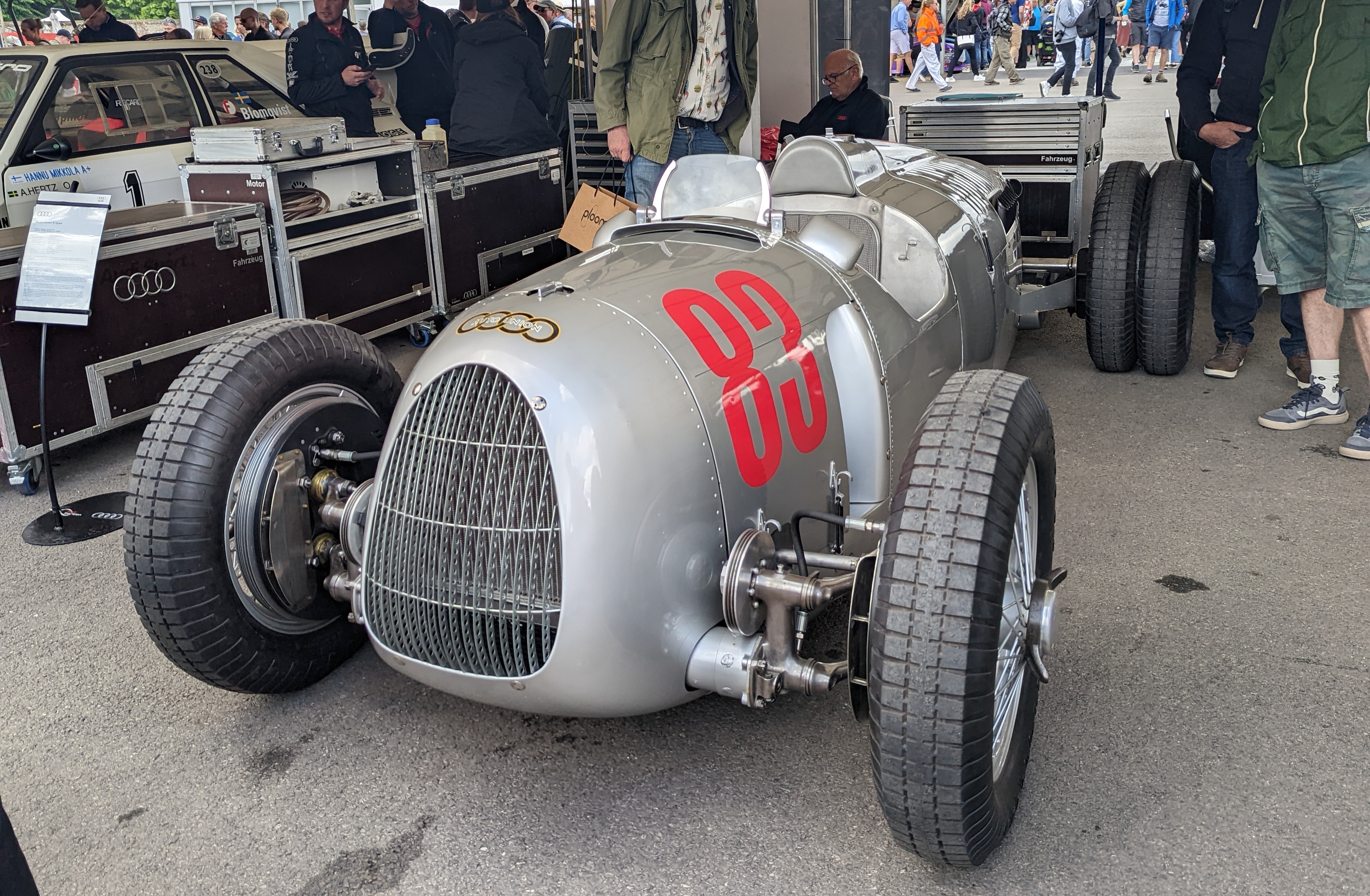
Image: Calreyn88 · CC BY-SA 4.0 Auto Union Type C
- Manufacturer / organisation
- Auto Union
- Design attribution
- Development of Ferdinand Porsche’s V16 architecture with Auto Union’s racing engineers.
The six-litre Type C carried the A/B concept into the 1936 and 1937 seasons. Bernd Rosemeyer became European champion in 1936.
What followedPorsche’s contract ended before the new 1938 formula. Audi attributes the subsequent V12 Type D to Robert Eberan von Eberhorst, rather than Ferdinand Porsche.
- Agriculture
Type 110 and the Volksschlepper programme
- Manufacturer / organisation
- Porsche engineering office
- Design attribution
- Ferdinand Porsche and the engineering-office team
The small Type 110 tractor belonged to the office's agricultural work. Porsche Engineering identifies its air-cooled two-cylinder layout as a starting point for the later people's tractor and post-war tractor families.
What followedPrototype work fed later tractor families.
- Racing & record cars
Mercedes-Benz T 80 record car
- Manufacturer / organisation
- Mercedes-Benz / Daimler-Benz
- Design attribution
- Commissioned from Ferdinand Porsche’s engineering office by Daimler-Benz.
The six-wheeled record project combined a special chassis with a Daimler-Benz DB 603 aircraft engine. Porsche’s account dates the commission to 1937 and test-stand work to 1939.
What followedWar prevented the planned land-speed-record attempt. Proposed speeds were engineering targets; the T 80 never established a land-speed record.
- Road cars
Type 114 mid-engined sports-car proposal
- Manufacturer / organisation
- Porsche engineering office
- Design attribution
- A pre-war proposal by the Stuttgart engineering team; not a production Porsche.
The proposed streamlined car used a water-cooled 1.5-litre V10 in a mid-engine layout. Porsche’s historical account places it on the drawing board in 1938.
What followedThe outbreak of war ended the project before a car was built. Its proposed engine figures and performance cannot be treated as results from a running prototype.
Original sources
- Life & company history
Engineering under National Socialism
- Manufacturer / organisation
- Porsche engineering office and client factories
- Design attribution
- Company history and Ferdinand Porsche's political involvement
Military commissions formed part of Porsche's involvement with National Socialism. The Porsche Museum documents tank development and the use of forced labourers in Stuttgart during the 1940s.
What followedThis context accompanies the military projects; technical descriptions do not remove their political and human consequences.
Original sources
- Road cars
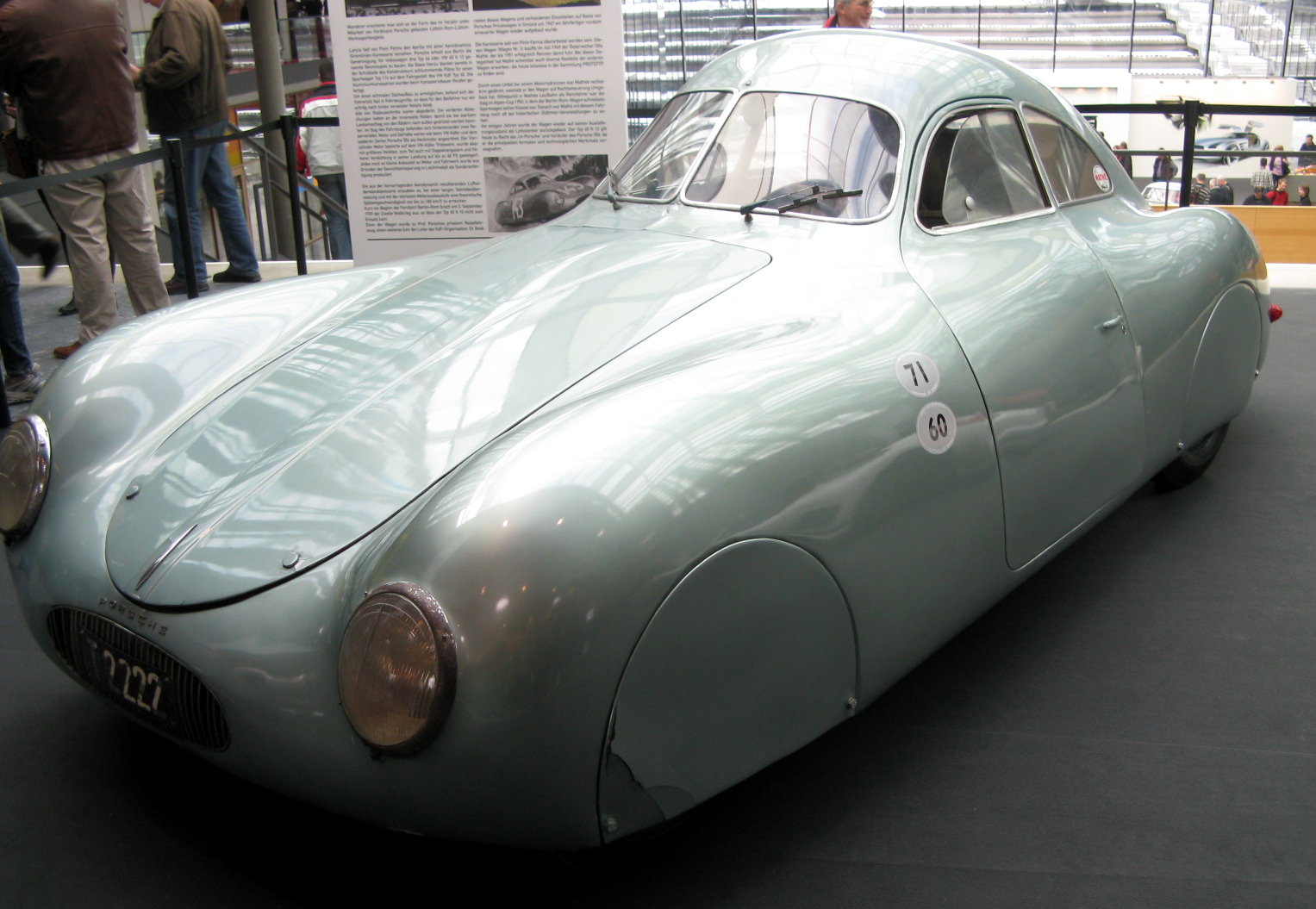
Image: MartinHansV · CC BY 3.0 Type 64 Berlin–Rome car
- Manufacturer / organisation
- Porsche engineering office / Volkswagen-based project
- Design attribution
- Engineering-office project; streamlined body design associated with Erwin Komenda.
The Type 64 used Volkswagen/KdF mechanical foundations in a streamlined sports-car body. It belongs to Ferdinand Porsche’s engineering-office period, before Porsche’s own sports-car marque began in 1948.
What followedIts body ideas fed the later 356. The subsequent sports-car manufacturer was developed under Ferry Porsche; the Type 64 should not be presented as a production Porsche range from 1939.
- Military & wartime
VK 30.01 (P): an earlier tank proposal
- Manufacturer / organisation
- Porsche prototype engineering
- Design attribution
- Porsche's competing tank-development team
Porsche and Henschel tested competing designs for the German Army's roughly 30-tonne tracked-vehicle requirement.
What followedChanging demands for armour and armament ended both projects; they were steps toward the larger Tiger competition.
- Military & wartime
Volkswagen Type 82 Kübelwagen
- Manufacturer / organisation
- Volkswagen
- Design attribution
- Porsche engineering office; Volkswagen manufacture; Ambi Budd bodywork
Volkswagen records Porsche-built pre-series vehicles before factory production began. This military derivative of the KdF car used an open body and increased ground clearance.
What followedIt entered wartime production at Volkswagen, whose archive also documents the factory's extensive use of forced labour.
Original sources
- Military & wartime
VK 45.01 (P): the Porsche Tiger proposal
- Manufacturer / organisation
- Porsche prototype engineering / Krupp turret
- Design attribution
- Ferdinand Porsche and the competing Porsche development team
Porsche's proposal competed with Henschel for the larger Tiger requirement, using an unconventional drive system and a Krupp turret.
What followedReliability and material-supply problems contributed to its rejection. Henschel's design became the production Tiger I.
- Military & wartime
Volkswagen Type 166 Schwimmwagen
- Manufacturer / organisation
- Volkswagen
- Design attribution
- Porsche KG development; Volkswagen manufacture; Ambi Budd hull
Following work on a larger amphibian from 1940, Porsche KG shortened and narrowed the vehicle for the military requirement. Volkswagen began series production of the compact Type 166 in August 1942.
What followedThe amphibian was a Volkswagen military product, rather than a Porsche sports-car model.
Original sources
- Military & wartime
Ferdinand / Elefant tank destroyer
- Manufacturer / organisation
- Conversion of Porsche-designed tank chassis
- Design attribution
- Derivative of the rejected Porsche tank chassis; not the production Tiger I
Existing Porsche-project chassis were converted into tank destroyers with a fixed armoured superstructure, different engines and a long 88 mm gun.
What followedThe Ferdinand, subsequently called Elefant, shows how a rejected prototype programme could feed a different wartime production vehicle.
- Military & wartime
Type 205 Maus
- Manufacturer / organisation
- Porsche engineering / Krupp turret
- Design attribution
- Porsche tank development with Krupp responsible for the turret
The Porsche Museum identifies Maus as project 205. The Tank Museum documents its development, increasing weight and the difficulties of the super-heavy tank programme.
What followedProduction was cancelled in 1943, although two pre-production vehicles reached testing in late 1944. It did not become a normal operational production series.
- Agriculture
Winches, tractors and practical work in Gmünd
- Manufacturer / organisation
- Porsche engineering office
- Design attribution
- Ferry Porsche and the post-war team
The post-war workshops worked on winches and tractors and repaired former military vehicles. Practical engineering helped sustain the business before the sports-car marque began.
What followedIndustrial work continued alongside the emerging sports-car plans; the company did not change direction in a single clean break.
Original sources
- Racing & record cars
Cisitalia Type 360 Grand Prix project
- Manufacturer / organisation
- Cisitalia
- Design attribution
- Ferry Porsche and the Gmünd engineering team
Cisitalia commissioned the post-war team to develop an advanced Grand Prix car with all-wheel drive. Porsche Engineering dates the completed Type 360 to 1947.
What followedFinancial circumstances prevented its racing career. The commission helped fund the family business's new start.
The turning point · 8 June 1948
From engineering office
to sports-car marque.
Ferry Porsche and his team created the 356 No. 1 Roadster. Its operating permit marks the beginning of Porsche as a sports-car marque. A famous engineering name became the badge on its own sports cars; the sporting reputation was built in the years that followed.
Ferdinand Porsche’s earlier career and Ferry Porsche’s sports-car leadership are different chapters. The transition in 1948 did not end agricultural or client engineering.
- Road cars
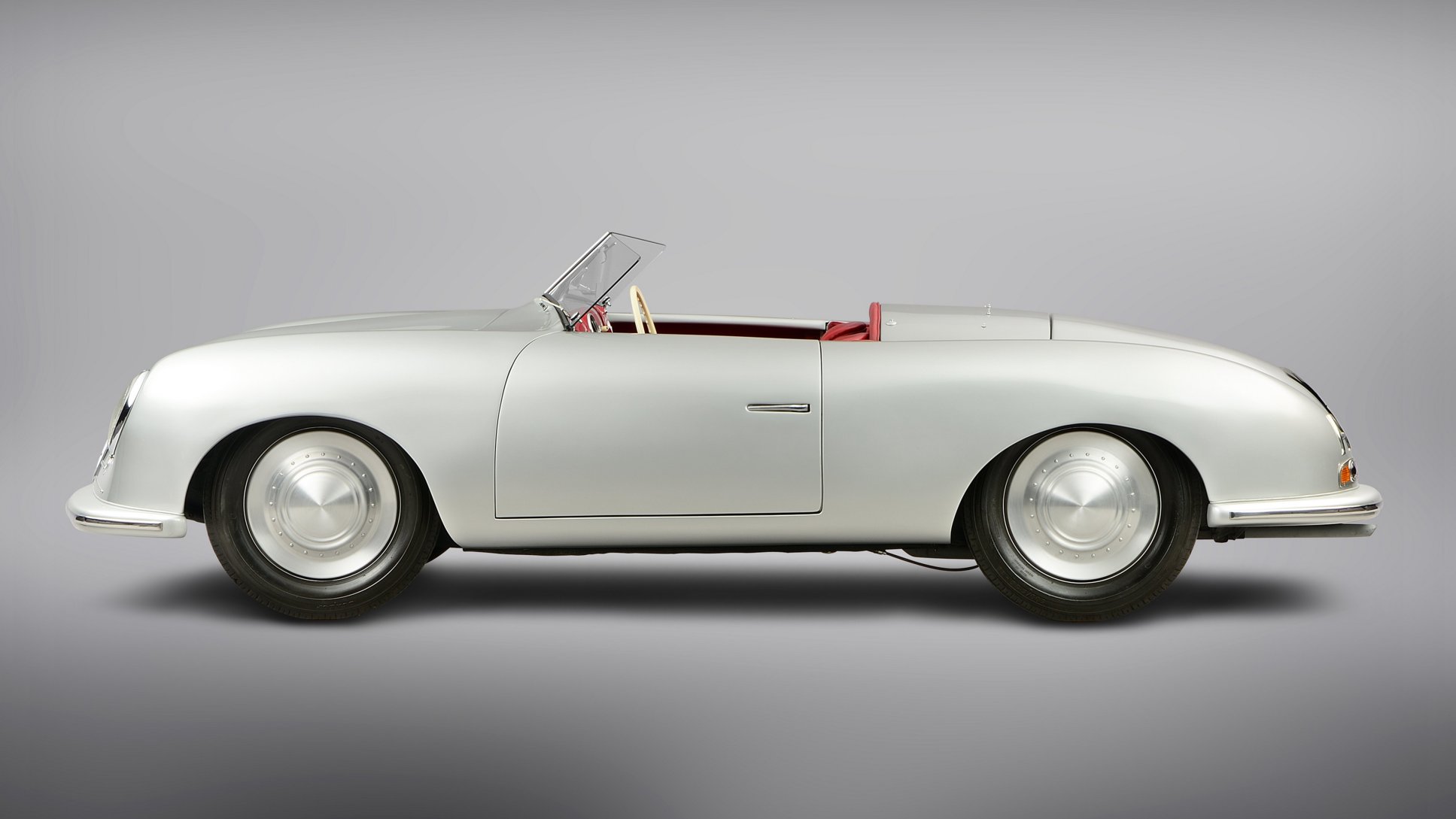
Image: Porsche AG · Manufacturer press image · editorial use 356 No. 1: the Porsche sports-car marque begins
- Manufacturer / organisation
- Porsche
- Design attribution
- Ferry Porsche's programme and the Gmünd team
The 356 No. 1 Roadster received its operating permit in Austria on 8 June 1948. This is the clear change from engineering for clients to a sports car carrying the Porsche name.
What followedThe rear-engined production 356 followed. Ferry Porsche's sports-car programme is a distinct chapter from his father's earlier work.
- Life & company history
Ferdinand Porsche's lifetime closes
- Manufacturer / organisation
- Porsche family history
- Design attribution
- Ferdinand Porsche (1875–1951)
Ferdinand Porsche died in Stuttgart on 30 January 1951, aged 75.
What followedLater vehicles may continue his engineering legacy, but their design cannot automatically be attributed to him personally.
Original sources
- Racing & record cars
356 SL: a sports-car reputation built through racing
- Manufacturer / organisation
- Porsche
- Design attribution
- Ferry Porsche's company, the works team, Auguste Veuillet and Edmond Mouche
The 356 SL secured Porsche's first class victory at Le Mans in 1951, with Veuillet and Mouche driving.
What followedThis was a class win, not an overall victory. It marked an early step in building the sports-car identity that developed over subsequent decades.
Original sources
A parallel branch · Agricultural successors
The tractors carried
the engineering forward.
Early Porsche tractor development led to later Allgaier and Porsche-Diesel vehicles. Models produced after Ferdinand Porsche’s death in 1951 are presented as successors in that lineage, not as vehicles he personally designed in their final form.
Return to the original tractor development →- Agriculture
Allgaier AP 17
- Manufacturer / organisation
- Allgaier
- Design attribution
- Porsche-derived engineering, manufactured by Allgaier
A 1949 agreement brought Porsche tractor engineering to Allgaier. The AP 17 became the successful production result in 1950.
What followedThis agricultural branch developed alongside Porsche sports cars.
- Agriculture
Allgaier A111
- Manufacturer / organisation
- Allgaier
- Design attribution
- Post-1951 development in the Porsche-derived tractor family
The A111 used standardised components to reduce costs and served farms moving from animal traction to mechanisation.
What followedIts 1952 production start was after Ferdinand Porsche's death; it belongs to the tractor lineage rather than his personal late work.
- Agriculture
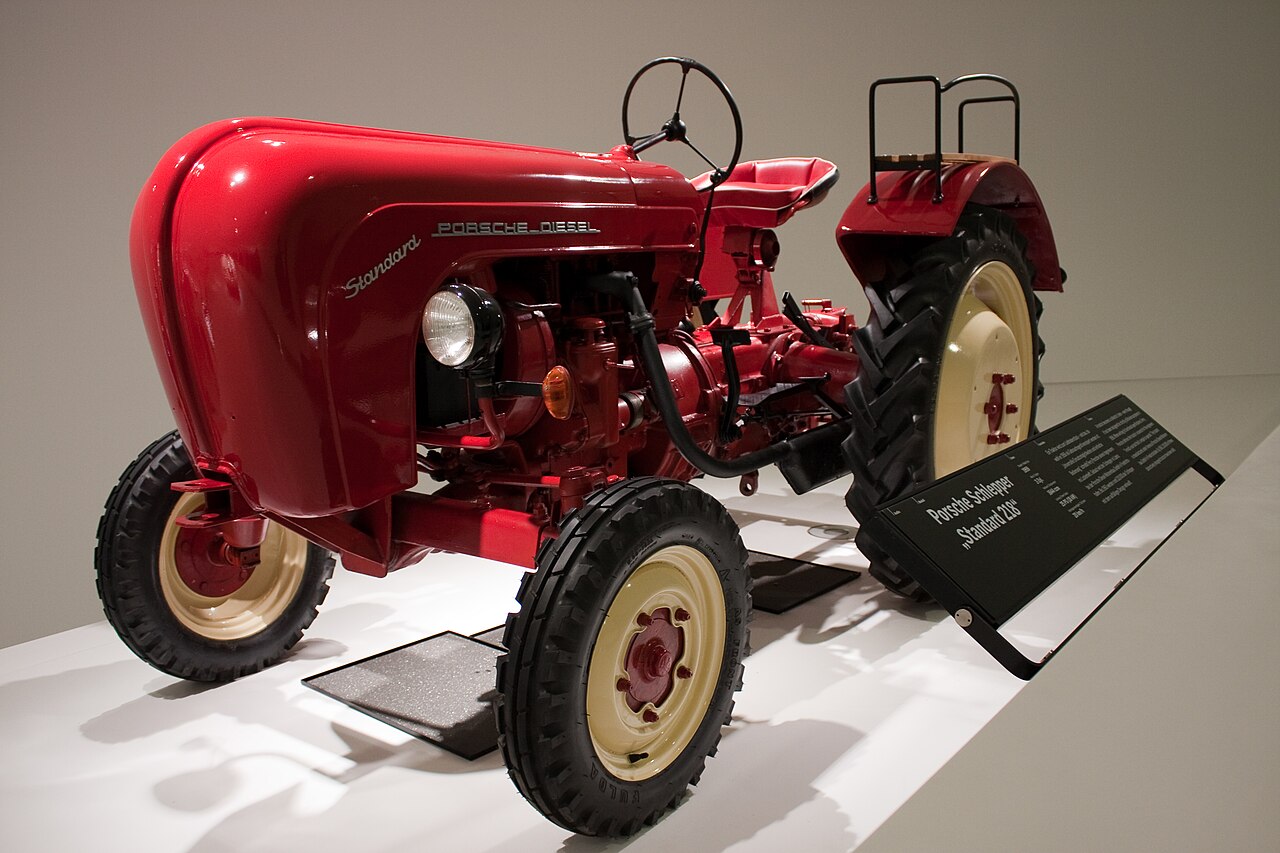
Image: Dennis Irrgang · CC BY 2.0 Porsche-Diesel takes over tractor manufacture
- Manufacturer / organisation
- Porsche-Diesel-Motorenbau GmbH / Mannesmann
- Design attribution
- Later company development of the agricultural branch
After Allgaier left tractor manufacture, Mannesmann continued production at Manzell under the Porsche-Diesel-Motorenbau name.
What followedThe Porsche name now identified a separate tractor business as well as the sports-car manufacturer.
- Agriculture
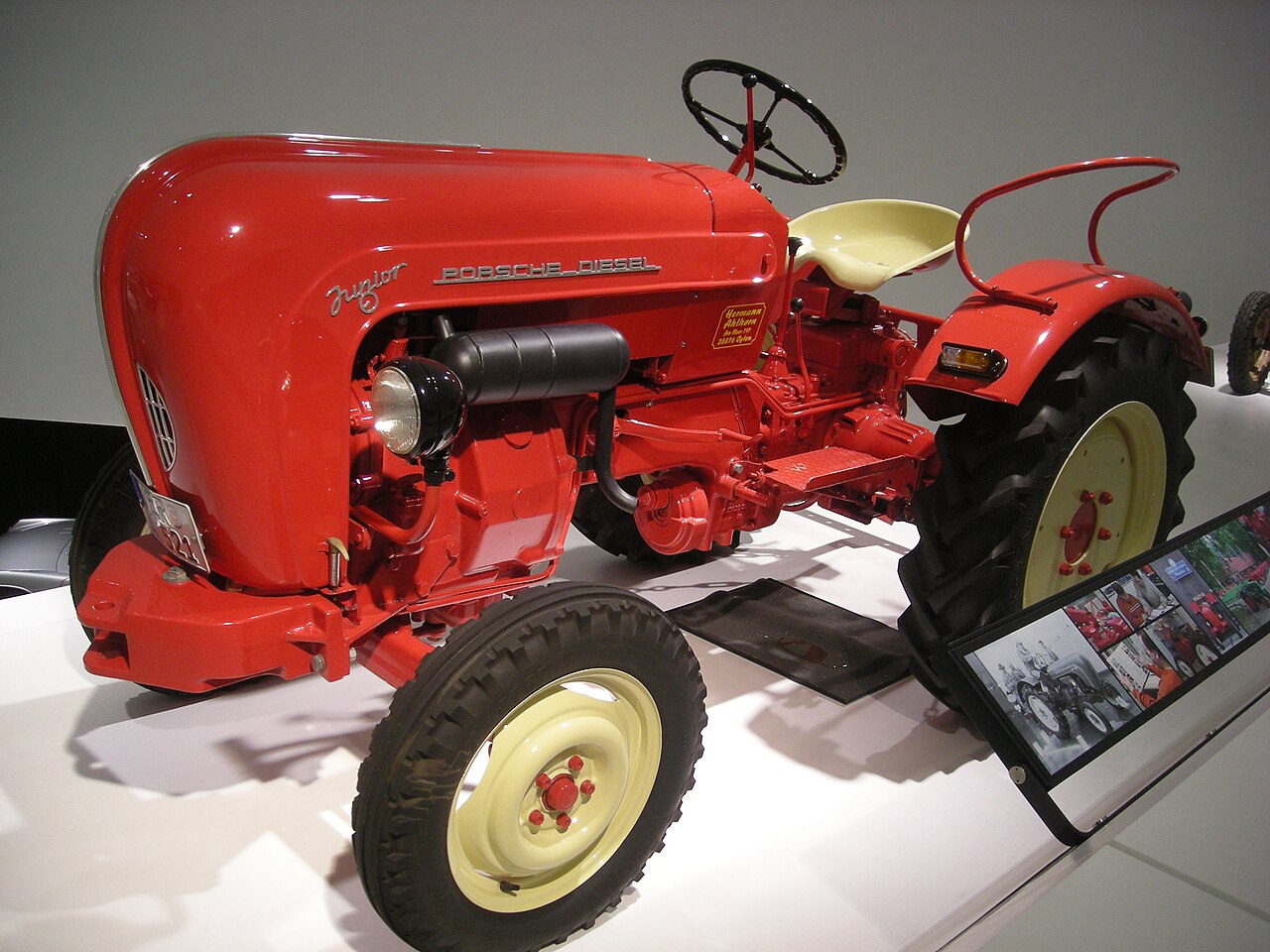
Image: Michael Barera · CC BY-SA 4.0 Junior, Standard, Super and Master
- Manufacturer / organisation
- Porsche-Diesel-Motorenbau GmbH
- Design attribution
- Successor vehicles; collection dates do not establish personal design by Ferdinand
The later tractor range included Junior, Standard, Super and Master. The fahr(T)raum collection records a 1958 Junior 108 L and Super N 308, a 1960 Master 418 and a 1961 Standard T 217 S.
What followedThese are recorded example years, not asserted launch dates for every series. The tractors continued in parallel with the sports cars after Ferdinand's lifetime.
- Agriculture
The tractor-production chapter ends
- Manufacturer / organisation
- Porsche-Diesel-Motorenbau GmbH
- Design attribution
- Later tractor-company history, twelve years after Ferdinand's death
The fahr(T)raum museum dates the end of Porsche-Diesel tractor production to 1963 and attributes the closure to strong competition.
What followedThe surviving tractors remain a separate part of Porsche engineering history; the sports-car business continued.
Chapter two continues
A sports-car identity.
Many paths forward.
Follow the later 911, transaxle cars, Boxster and Cayman, Panamera and SUV families in their own histories. The prototype archive explains which ideas reached production and which took another path.
Explore the separate Porsche family lines Browse the photographed prototypes →Attribution and historical context
This is a sourced research timeline, not a claim that one person created every component of every listed vehicle. Ferdinand Porsche’s personal work, technical leadership, the Porsche office’s client projects and later developments are identified separately. National Socialism, military engineering and forced labour are part of this history and are addressed alongside the technical projects.
Dates can identify a design, a prototype, a public presentation or the start of production; each entry explains which. Photographs may depict later surviving or restored vehicles. Captions and credits identify that distinction where the source establishes it.