1972–1973 · Can-Am sports prototypes
917/10 → 917/30
The turbocharged open 917 branch moved the programme beyond its Le Mans coupés. The 917/30 and Mark Donohue dominated the 1973 Can-Am championship with Penske.
Porsche — 917/30 and RS Spyder competition with Penske ↗Porsche — turbo racing development from Can-Am to GT2 and prototypes ↗1972–1974 · 911-based GT racing
Carrera RSR 2.8 / 3.0
RSR development was already active in late 1972 for the 1973 season. The 2.8-litre cars and later three-litre developments linked racing success to an expanding customer programme.
Porsche Museum — the 1972 development car and 1973 RSR campaign ↗Porsche — RSR 3.0 and 917/30 technical references ↗1974 · Works development racer
Carrera RSR Turbo 2.1
The turbocharged 2.1-litre RSR finished second overall at Le Mans in 1974. It explored a different technical direction from the naturally aspirated customer RSR.
Porsche — turbo racing development from Can-Am to GT2 and prototypes ↗1976–1979 · Group 4 and Group 5 GT branches
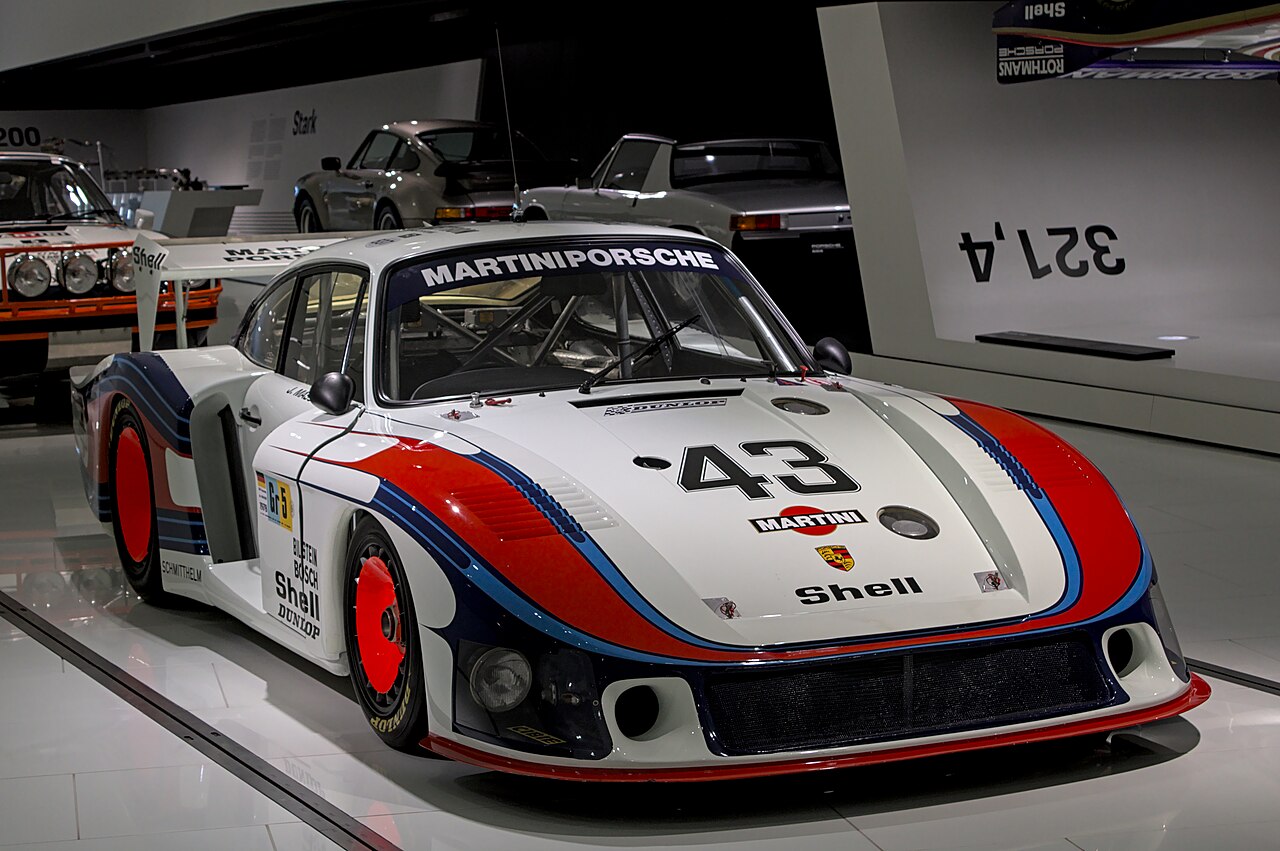
934 / 935 → 935/78 and K3
The 934 and much more modified 935 served different rule sets. Factory development reached the long-bodied 935/78 Moby Dick; Kremer’s 935 K3 won Le Mans overall in 1979. A K3 is not simply another name for Moby Dick.
Porsche — turbo racing development from Can-Am to GT2 and prototypes ↗Porsche — Le Mans chronology, 935, 936, 956, 962 and 1990s developments ↗1976–1981 · Open endurance prototype
936 Spyder
A dedicated prototype line ran alongside the 911-derived racers. The 936 won Le Mans in 1976, 1977 and 1981, with continuing engine and body development.
Porsche — Le Mans chronology, 935, 936, 956, 962 and 1990s developments ↗1982–1989 chapter · Ground-effect endurance prototypes
956 → 962 IMSA / 962 C
The 956 introduced an aluminium monocoque and ground-effect aerodynamics. The 962 branches adapted the concept for different regulations. Together the 956 and 962 C won Le Mans from 1982 through 1987; their careers continued beyond this chapter.
Porsche — Le Mans chronology, 935, 936, 956, 962 and 1990s developments ↗Porsche — turbo racing development from Can-Am to GT2 and prototypes ↗