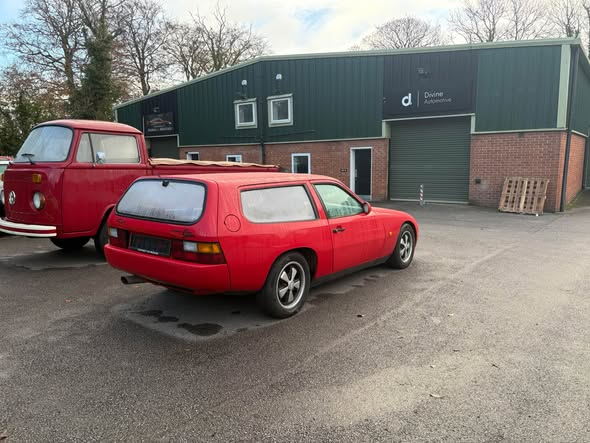
A long, level roof transforms a familiar transaxle Porsche. The Cargo belongs to the history of independent specialists exploring what a Porsche could carry, alongside the factory's own experiments with space and practicality.
Ekkehard Zimmermann · dp motorsport
A different brief for a Porsche specialist.
Founded by Ekkehard Zimmermann in 1973, dp motorsport became known for its Porsche bodywork. Its work with Kremer included the 935 K3 that won Le Mans in 1979. The company's own history identifies the 1980s 944-based dp44 Cargo as another design highlight: a sporting estate developed by the specialist.
The attraction was practical as well as visual. In its retrospective on Zimmermann's career, dp describes Scandinavian customers benefiting from the different tax treatment of these conversions. The estate body offered an alternative way to enjoy a front-engined Porsche.
dp motorsport — company history and 1980s dp44 Cargo ↗dp motorsport — Zimmermann retrospective and Scandinavian customer context ↗924 Cargo & 944 / dp44 Cargo
One idea, more than one donor.
Cargo conversions are documented on both the 924 and the wider-bodied 944. A 2016 sale report described a 1977 924 converted in 1986, with 924 Turbo running gear and a 944 nose. Those are attributed details of that particular advertised car; they do not establish the identity of every red Cargo.
The silver reference photograph shows a 944 Cargo, with a wider body than the likely 924-based red car in the opening photograph. Different donors and later modifications help explain why surviving Cargos do not all look alike.
Bring a Trailer, 23 October 2016 — contemporaneous report quoting the 924 seller ↗Original photographer — 944 DP Cargo at Maastricht ↗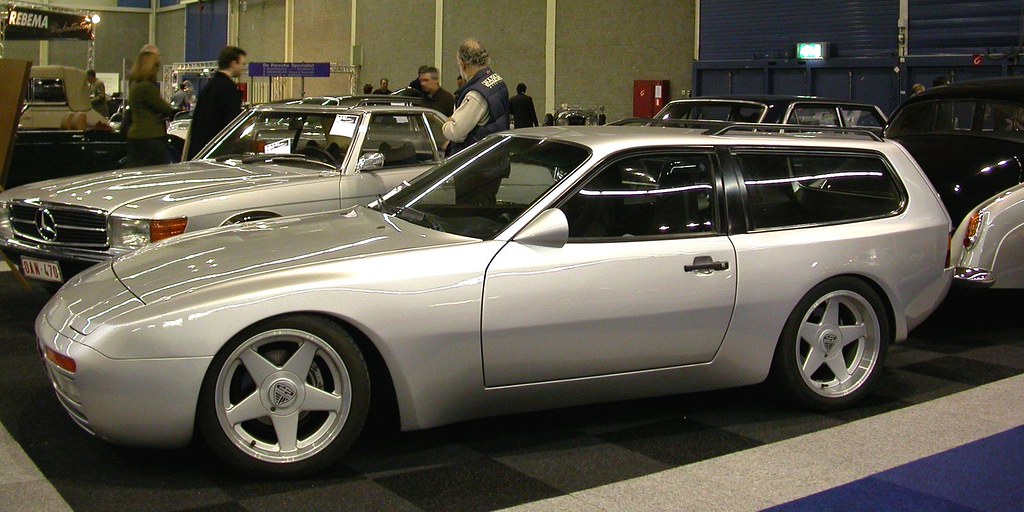
A small-batch alternative
Built as conversions, outside the factory range.
The Cargo reached customers as a specialist conversion. It is not a cancelled factory prototype or an official estate derivative from Porsche's period catalogue. Published accounts give differing totals and sometimes combine the 924 and 944 branches, so this history does not assign a verified final production number.
Engine, power, seating and performance must be tied to an individual donor and its documented modifications. We have no independently verified Cargo-wide acceleration or maximum-speed result. A standard 924 or 944 figure would not automatically describe a converted example.
dp motorsport — identifies the 944-based conversion ↗Period sale reporting — vehicle-specific claims and a reported count, rather than a verified production register ↗Our reading of the design
More luggage. A different kind of practical Porsche.
The Cargo makes an interesting companion to the later Panamera Sport Turismo and Taycan estate-body stories. The shared theme is usable space within a sporting shape; that comparison is our interpretation, not evidence of a direct development relationship.
It also differs from the search for four genuinely usable seats. Extending a roof and luggage area does not, by itself, prove that the rear seats became adult-sized. That distinction keeps the Cargo's achievement clear: an independent exploration of the Porsche estate.
Sources reviewed 2026-11-02. Historical coachbuilding is kept separate from the prototype catalogue. The silver reference photograph depicts a 944 Cargo; the red contributor photograph suggests a 924-based example but cannot establish its chassis history or specification.